


Resilience Ridge is designed for supply chain leaders ready to move beyond box-ticking and build future-proof operations. Across manufacturing, wholesale, retail and logistics companies are facing mounting challenges: escalating supply risks, increasing pressure around Scope 3 reporting, and the complexity of developing Digital Product Passports that meet regulatory demands while delivering business value.
In today’s volatile environment, compliance is no longer enough. Companies must rethink how they manage risk, ensure transparency and collaborate across ecosystems to create resilient, adaptive supply chains. As highlighted in previous editions, the shift from obligation to opportunity is essential to remain competitive in a rapidly changing landscape.
In the breakout sessions solution providers will demonstrate how to tackle these challenges with a strategic, long-term perspective. Expect concrete approaches to integrate supply risk management, sustainability data and product traceability into core operations, transforming compliance into a driver of resilience, agility and sustainable growth.
Break-out Sessions

1.30 - 1.50 PM
From Tick-Box Due Diligence to Real Resilience
Speaker: Younes Bouhab, ESG Solutions Lead
Supplier due diligence has outgrown the onboarding form. New regulations, sanctions lists that change constantly, and ESG claims that now must hold up under actual scrutiny have all moved the goalposts. A questionnaire filled in once and filed away doesn't cut it. Regulators, customers, and auditors want to see that you know what your third parties are doing now, not what they told you twelve months ago.
In this session, osapiens walks through what it takes to move due diligence out of the annual-review cycle and build it into how the business actually runs.
We'll cover three topics:
Risk doesn't sit in tidy categories anymore. Human rights, ESG, sanctions, operational disruptions: they overlap, and a yearly review can't catch what shifts week to week. We'll talk about where the real blind spots are and what genuine end-to-end visibility looks like.
Your supplier data is probably scattered across too many tools. Records in one system, certificates in another, assessments in spreadsheets, incident reports in someone's inbox. When an auditor asks a question, finding the answer becomes its own project. We'll show what it looks like when this lives in one place that actually holds up to scrutiny.
Continuous due diligence, in practice. Real-time risk signals, workflows you can configure without engineering help, and a direct channel to suppliers instead of chasing them over email. The goal is catching issues as they surface, not weeks later.
You'll leave with a clear sense of what good looks like today, and what to do about the gap between what regulators expect and what your current setup can actually prove.

2.05 - 2.15 PM
Volatility as the new normal: Managing bullwhip
Speaker: Joeri Spoor, Senior Manager Digital Supply Chain, IG&H
Supply chain disruption is the new normal. There is no relief cycle anymore because each disruption is followed by the next. Geopolitics, energy shocks, and trade restrictions are amplifying the bullwhip effect as companies fall back on buffers, overordering, and short‑term fixes. These reactions feel safe, but they add noise rather than resilience.
We saw this dynamic during COVID‑19, when small demand signals turned into massive upstream swings. Today’s drivers are different and more persistent. Wars and sanctions disrupt raw materials, energy price spikes distort cost structures, and geopolitical uncertainty undermines forecasts. Companies react faster, but not necessarily smarter.
This presentation explores why the bullwhip effect is resurfacing under today’s macroeconomic and geopolitical pressures, and why traditional fixes no longer work. Volatility is not temporary: it must be designed for in our supply chains. Leading companies are already shifting toward scenario‑based planning, sharper demand sensing, smarter decoupling, and stronger cross‑functional decision‑making to absorb shocks without overreacting.


2.30 - 2.40 PM
High quality AI-driven decision making in action
Speakers:
Stan Fransen, Supply Chain AI expert at Deloitte
Lonneke Knipscheer, Consumer Supply Chain Leader at Deloitte
In today's complex operations, the quality of your team's decisions directly impacts the bottom line. But how can you empower your teams to make faster and consistently better, data-driven decisions?
This session introduces Decision Intelligence: systematically improving decisions by modelling the decision‑making process and equipping it with analytics and automation. We’ll show how the power of AI can be leveraged to strengthen decision making in the heart of your operations.
To bring this concept to life, we will showcase an example: AI-based Return Grading, complementing a labour-intensive process with computer-vision.
In 10 minutes, you'll learn:
- How AI supports the decision-making process
- The surprising speed to value (from idea to PoC in just eight weeks)
- The business impact

2.55 - 3.05 PM
From CO2 data to cost reduction
Speaker: Ivo de Vos, Business Consultant, BigMile
At inNOWvate, we will explore how companies can move from CO2 calculation to real operational and financial impact. Sustainability is no longer just about reporting obligations or future ambitions — it is becoming a direct driver of efficiency and cost control.
During this session, we will first dive into the current legislation and discuss why accurate CO2 calculations are becoming essential for transport and logistics operations. We will also look at why calculation alone is not enough. Data only becomes valuable when it creates useful insight.
From there, we will explore which findings truly matter. Which routes, transport modes, customers, or operational choices create the biggest impact on emissions and fuel consumption? Where are the hidden inefficiencies? And how can better visibility help teams make smarter day-to-day decisions?
Finally, we will focus on the step that matters most: turning insight into action. Because reducing CO2 is not only about sustainability goals — it also means using less fuel, improving efficiency, and lowering transport costs. Together, we will look at practical examples and concrete opportunities to make operations both greener and more profitable.
This session will get you on the right track to be more sustainable and more efficient and how a tool like BigMile can help you achieve that.

3.20 - 3.40 PM
People: the source of supply chain resilience or the weakest link?
Speaker: Melanie Salter, CEO of BOOM Global Network
What really makes a supply chain resilient? Systems, processes, and technology often take centre stage. This interactive session challenges that assumption.
Led by Melanie Salter, CEO of BOOM Global Network, this is not a traditional presentation. Instead, expect a candid, thought-provoking conversation that puts people at the heart of the discussion. With over 25 years of global supply chain experience, Melanie brings a practical perspective on how organisations build resilience and where they often fall short.
Through a series of thought-provoking questions, she will invite you to reflect on your own organisation. Are we relying on individuals to compensate for gaps in our systems? Why do we invest heavily in technology, yet often underinvest in the people expected to make it work? And as AI and automation reshape the landscape, are we truly preparing our teams for the future?
This session is designed to spark honest dialogue. You will hear how peers are approaching these challenges and gain fresh insights into how inclusive practices and better-designed organisations can drive performance and innovation.
If you are responsible for building a future-proof supply chain, this is your opportunity to step back, challenge assumptions and engage in a conversation that goes beyond the usual narratives.
Leave with a clearer view on how to strengthen the one factor that ultimately determines success, your people.

3.55 - 4.05 PM
The Hidden Journey of Scope 3: Sustainability Under Pressure
Speaker: Oliver Ritzmann, Founder and CSO at Gryn
How resilient transportation networks can sustain Scope 3 decarbonization amid disruption, cost pressure, and global uncertainty.
This theme is for:
- Supply chain, operations, and sustainability leaders
- Professionals responsible for risk management, compliance, and value‑chain transparency
- Organisations looking to strengthen resilience across complex supply networks
Topics & challenges
- Supply chain risk, disruption, and resilience
Scope 3 data, transparency, and reporting reliability
Digital Product Passports and regulatory pressure
Collaboration across extended supply‑chain ecosystems
What does this mean?
- Practical, case‑based insights
- Clear examples of moving beyond compliance
- Actionable takeaways for building resilient, future‑ready supply chains
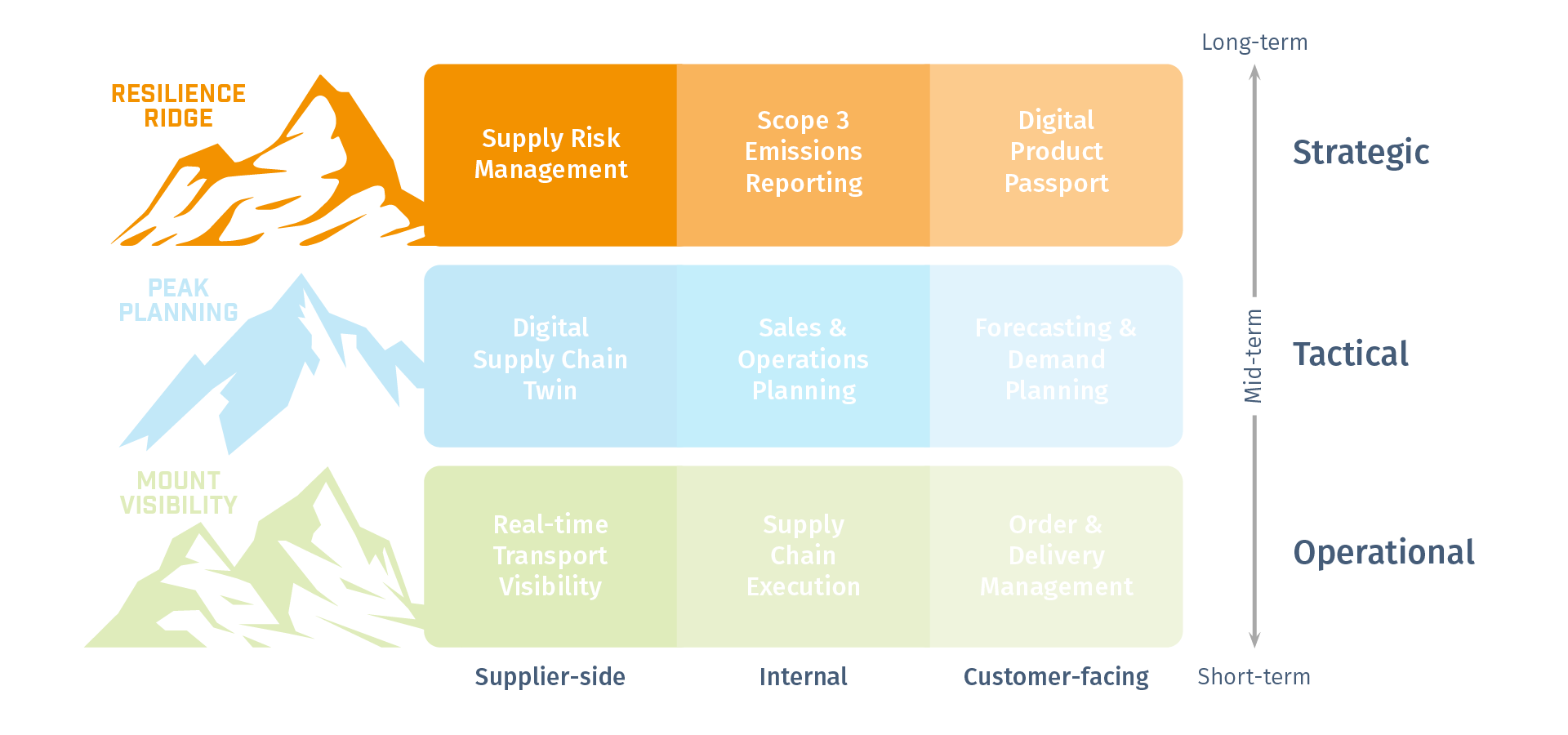
How to read this overview
The matrix above shows how the three break‑out themes connect across the supply chain and decision horizon. From Resilience Ridge (strategic, long‑term) to Peak Planning (tactical, mid‑term) and Mount Visibility (operational, short‑term), each theme addresses a different layer of supply chain decision‑making — from suppliers to customers.