


Peak Planning addresses the growing complexity faced by manufacturing, wholesale, retail and logistics companies. Increasing demand volatility, scarcity of materials, supply chain disruptions, import tariffs, fluctuating exchange rates and continuous cost increases are putting traditional planning approaches under severe pressure. As highlighted in last year’s track, static planning is no longer sufficient in a world defined by uncertainty and rapid change.
In the breakout sessions, solution providers demonstrate how companies can move beyond reactive planning towards dynamic, scenario-driven decision-making. Through the use of Digital Supply Chain Twins, innovative Sales & Operations Planning (S&OP) and Integrated Business Planning (IBP) software, and AI-driven forecasting and demand sensing, companies can simulate “what-if” scenarios, anticipate risks and balance demand, supply and financial objectives. These technologies enable more resilient and agile global planning on the tactical mid-term horizon.
Break-out Sessions

1.30 - 1.50 PM
From ordering to planning
Speaker: Jan Kraaijeveld, Sales Director at Slimstock
Most supply chains don’t plan — they react. Low stock? Order. Problems? Order more. Surplus? Stop. This isn’t planning, but a reflex. ERP systems, fear of missing out, and Excel adjustments reinforce this. Ordering feels like control — but it’s merely treating the symptoms. And in a world of growing volatility, shorter product lifecycles and more SKUs, that approach no longer scales.
The shift: from reacting to orchestrating. Scenarios instead of fixed parameters, orchestrated decisions instead of manual corrections, focusing on value rather than just availability.
Many companies have the data. But they lack the structure to make decisions based on it.
The winner in the supply chain isn’t the one who orders the fastest — but the one who makes the best decisions.

2.05 - 2.15 PM
Complex supply chains deserve simple planning
Speaker: Wouter Samama, Co-founder & CEO, OAASIS (ex-P&G, ex-Kraft Heinz)
Supply chain complexity is real. Volatile demand, dozens of suppliers, tiered pricing, multi-site production, constrained capacity, dependencies. And the planning process became as complex as the chain itself. Planners are drowning in dispersed systems, spreadsheets, chasing data and firefighting instead of making decisions, trying to keep up.
The irony: the companies with the most complex supply chains but best performance have the simplest planning processes and most powerful systems.
This session makes the case that great planning is not about adding more tools, more meetings, or more data. It is about getting the fundamentals right. Drawing on experience at P&G and Kraft Heinz — and on real implementations at fast-growing mid-market companies — Wouter Samama shows what genuinely simple, effective planning looks like in practice: clear cycles, the right constraints, AI doing what AI is good at, and planners freed up to think rather than firefight.
For mid-market companies this is now within reach. The same methodology of solver-based optimisation and AI-driven planning that large corporates use is now made accessible. And the impact for supply chain is disproportionately large for companies making making that step change.
Complex supply chain. Simple planning. Serious results.

2.30 - 2.40 PM
New Frontiers in Supply Chain Decisions with AI
Speaker: Evrim Övünç, SVP Sales & Marketing EMEA at Sophus
The biggest challenge in making good decisions is understanding and aligning their end-to-end supply chain implications. Sophus will explain how its technology evolved with AI to deliver prescriptive, optimised answers even to tactical and operational questions.

2.55 - 3.05 PM
Stop Asking ‘What If?’ Start Asking ‘What’s Best?’ Reducing Decision Latency Through Profit‑Led Planning
Speaker: Jack Cheesbrough, CEO at I-Plan
In today’s complex supply chains, the real challenge is not a lack of scenarios; it is the speed and confidence of decision‑making. As disruption becomes the norm, organisations often find themselves overwhelmed by options, debating trade‑offs while valuable time slips away.
In this session, I‑Plan CEO Jack Cheesbrough explores why decision latency is fast becoming the biggest constraint in modern planning. He explains why creating more scenarios rarely leads to better outcomes, and how scale, complexity and competing priorities can actually slow organisations down.
Jack will share how leading businesses are moving beyond scenario comparison towards profit‑led, optimisation‑driven decision generation. By anchoring decisions to a clear financial objective, an Ultimate Performance Indicator, teams can align faster, remove bias, and act with clarity even when conditions change.
The session also reframes planning as a continuous, adaptive capability rather than a periodic, high‑pressure activity. Attendees will leave with a practical new mindset: competitive advantage comes not from asking more “what ifs”, but from making better decisions, more often, in far less time.


3.20 - 3.40 PM
Data-Driven and Dynamic: Royal Auping’s journey through S&OP scenarios to creating financial results
Speakers:
Andrés Montes de Oca, Global Director, Supply Chain & Sales at Board
Erwin Flierman, S&OP Lead at Royal Auping
Discover how Royal Auping, the global premium bed and mattress manufacturer, transformed its Sales & Operations Planning (S&OP) process to better align demand, supply, and financial outcomes using Board.
In this session, Royal Auping will share how it secured stakeholder buy-in and drove user adoption across the organisation. Attendees will gain insight into the evolution of their planning processes, including how integrated sales and production forecasting enabled more agile, data-driven decision-making and improved financial performance.
Erwin will provide a candid perspective on the journey — highlighting key lessons learned, practical challenges, and valuable advice for supply chain and planning professionals embarking on their own S&OP transformation initiatives.


3.55 - 4.05 PM
Supply Chain Design Is Dead. Long Live Supply Chain Design.
Speakers:
Christophe Frere, VP of Sales EMEA, Optilogic
Alfons Willemsen, Partner, Involvation
When the next tariff drops, trade route closes, or demand signal shifts overnight, every team with a planning tool will run the same playbook. The organizations pulling ahead aren't better planners, they're designers. Here's how AI-driven supply chain design compresses weeks of scenario analysis into hours, removes the constraints that planning can only work around, and puts decision-ready insights in the hands of the people who need to act fast. Stop optimizing your constraints and start eliminating them.
This track is for:
- Supply chain, planning, and operations leaders
- Demand, supply and inventory planners
Topics & challenges
- Demand volatility and uncertainty
- Cost pressure, scarcity, and global disruptions
- Misalignment between demand, supply, and finance
What does this mean?
- Real‑world use cases of scenario‑based planning
- Insights into next‑generation S&OP and IBP
- Practical guidance on moving from reactive to proactive planning
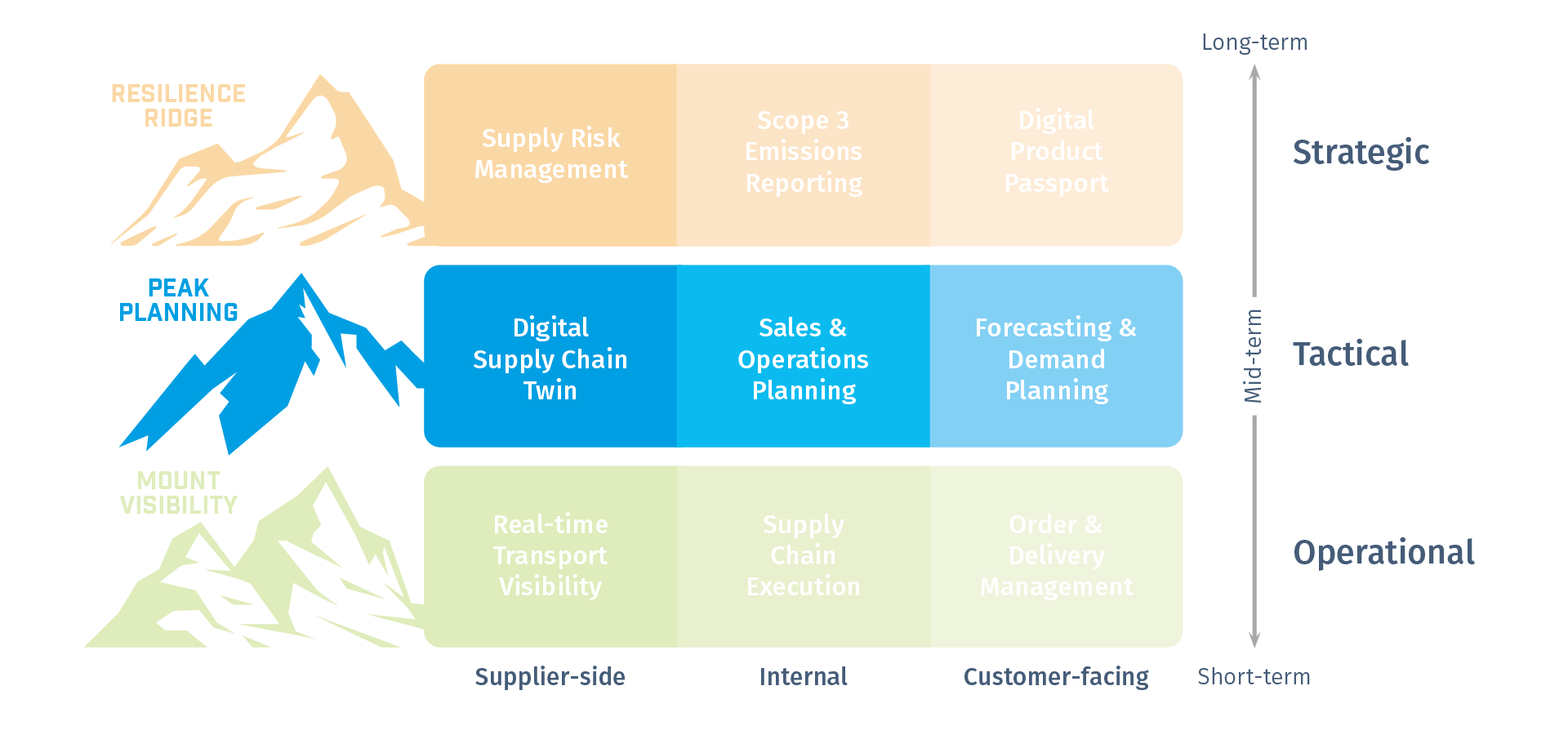
How to read this overview
The matrix above shows how the three break‑out themes connect across the supply chain and decision horizon. From Resilience Ridge (strategic, long‑term) to Peak Planning (tactical, mid‑term) and Mount Visibility (operational, short‑term), each theme addresses a different layer of supply chain decision‑making — from suppliers to customers.