


Mount Visibility addresses the growing short-term disruptions that manufacturing, wholesale, retail and logistics companies face when trying to secure supplies, fulfil demand and deliver goods on time in full (OTIF). Unexpected demand spikes, labour scarcity, strict inner-city regulations, rising e-commerce returns and increasing fuel prices are putting daily operations under severe pressure and exposing the limits of fragmented visibility.
In this rapidly changing environment, simply knowing where goods are is no longer enough. Real-time transport visibility platforms, modern logistics control towers, cross-functional command centers provide end-to-end insights across orders, shipments and inventory, enabling companies to detect disruptions early and respond faster.
Solution providers demonstrate how to move beyond visibility towards execution, showing how integrated platforms and digital control towers enable smarter order orchestration, dynamic delivery management and faster, data-driven decision-making to improve service levels, reduce costs and build more resilient supply chains.
Break-out Sessions

1.30 - 1.50 PM
When the supply chain shifts from reactive to predictive
Speaker: Stefan Maas, Commercial Director Benelux of Connected Load Carrier (CLC)
In today's retail landscape, organizations invest heavily in systems for forecasting, transport optimization and warehouse execution. Yet, one critical oversight remains: the movement of reusable load carriers between warehouses, distribution centers and stores. These invisible assets often fall outside the systems they’re investing in, leading to manual tracking, excess safety buffers and hidden operational costs.
At InNOWvate 2026, Stefan Maas, explores how to close this visibility gap. Supply chains are no longer linear, but they’re connected ecosystems that require real-time intelligence to function efficiently. Without transparency across physical flows, circular logistics can’t scale and inefficiencies remain buried in daily operations.
CLC transforms physical movement into a digital intelligence layer. By connecting reusable assets across the entire network, movement becomes data. This data can be translated into measurable outcomes. This shift enables retailers to move from reactive firefighting (characterized by manual reconciliation and chronic shortages) to predictive, optimized operations
CLC builds a scalable foundation through modular physical infrastructure, asset solutions that grow with the network and commercial data points that deliver insights such as loss detection, idle time alerts and return flow visibility. The approach is impact-driven: value is measured in operational outcomes like improved asset availability, reduced losses and lower emissions; not data volume.
The result is a supply chain that is visible, intelligent and built for circularity.
Visit CLC at booth 1 to discover how turning physical flows into digital intelligence can replace manual friction with proactive, scalable control.

2.05 - 2.15 PM
Digitization of Transport Documents like e-CMR
Speaker: Walter Schutte, Senior Business Consultant at Transporeon
As the logistics industry accelerates towards digital transformation, transport documentation is becoming a key focus area. In this session, Transporeon explores how digital transport documents such as e-CMR are reshaping supply chain operations by reducing paperwork, improving real-time visibility, and enabling more efficient collaboration between shippers, carriers, drivers, and recipients.
The session will provide insights into the current legal and technological landscape surrounding e-CMR and eFTI initiatives across Europe, including upcoming regulatory developments and implementation timelines. Attendees will learn how digital documentation can streamline processes from warehouse and yard operations to proof of delivery, while also improving compliance, data quality, and sustainability performance.
Through practical examples and real-world use cases, Transporeon will demonstrate how digital workflows help eliminate manual administration, accelerate payment cycles, enhance operational transparency, and reduce friction between supply chain partners. The presentation will also address common barriers to adoption, such as interoperability challenges, fragmented systems, and industry readiness.
Participants will gain a clear understanding of why now is the right time to start the transition towards paperless logistics and how e-CMR can serve as the foundation for future digital supply chain initiatives.

2.30 - 2.40 PM
Awesome Logistics. Made Simple. By Viya.
Speaker: Johan de Grijff, Commercial Director at ShipitSmarter
Johan de Grijff (Commercial Director, ShipitSmarter) explains how a modern TMS solves the most relevant pain points by acting as the integration layer between shippers and their carrier network, not just for execution or tracking, but for the full shipment life cycle.
When you book a shipment through a single platform connected to all your carriers, you don't just save time at the time on booking. You also unlock the option to compare all your carrier rates, apply intelligent business rules, real-time tracking, automated exception alerts, and freight settlement, all flowing from the same connection, without manual intervention.
ShipitSmarter offers Viya, a modern Transport Management System used by European manufacturers and distributors to plan, ship, track, and improve their logistics operations. In Viya you connect a new carrier in minutes and becomes the single operational bridge between your warehouse and your entire carrier network.
This session is for supply chain professionals who want less manual work, better data, and a carrier strategy that actually scales.

3.20 - 3.40 PM
Beyond Excel, without the APS burden -
how Honeycomb powers smarter planning
Speaker: Niek van de Crommert, Commercial Director at EyeOn
Many supply chain teams are caught in the same trap. A full APS is too expensive, too complex, and too disruptive to implement. So they stay in Excel, or Excel-like environments, that are fragile, barely scalable, and dangerously dependent on the one person who built them years ago.
The result: planning that works until it doesn't. And when it breaks, it breaks badly.
Honeycomb is EyeOn's answer to this problem. Built on more than 25 years at the intersection of supply chain consulting and data science, long before AI became a boardroom topic, it is a lightweight system of intelligence that does the heavy lifting without the implementation burden of a traditional APS. It structures the data, workflows, and algorithms that modern planning requires, so organisations can actually apply advanced analytics and AI in ways that deliver value, not just in pilots.
Honeycomb is built on the strong technical foundation of Databricks and includes a library of battle-tested supply chain algorithms, pre-packaged workflows, and a standardised supply chain data model. It is not a replacement for your existing systems. It is the intelligent layer that makes them work harder.
For organisations that already have an APS, Honeycomb goes further. Through its API, advanced algorithms are available as a plug-in directly into existing planning environments, adding an AI layer without replacing what is already there.
In this session, Niek van de Crommert, Commercial Director at EyeOn, will share the vision behind Honeycomb, the problem it was built to solve, and why the gap between Excel and a full APS is exactly where the next generation of supply chain intelligence belongs.

3.55 - 4.05 PM
Beyond the Warehouse: The Visibility Gap
Speaker: Elin Holm, Business Development Manager at Ventory
Every supply chain investment in visibility assumes the same thing: that inventory stays inside a system. But for field-intensive operations, a significant share of stock never does. It leaves the warehouse and moves into the world, sitting at customer sites, in service vehicles, at distributed field locations, and from that moment, it becomes invisible.
No one knows what is there. No one knows what has been used. Replenishment happens based on guesswork, stockouts are discovered too late, and reconciliation gets done manually at the end of the month, if at all.
Companies already have ERPs, WMS platforms, and transport visibility tools. But these systems were built for the warehouse, not for what happens beyond it. The gap is not about lacking technology, it is about having the wrong technology covering the wrong part of the chain
Ventory is a field inventory management platform built for exactly this problem. It extends visibility beyond the warehouse to every location where stock lives outside a formal system, giving field teams a simple mobile tool to track and manage inventory, and giving operations leaders accurate, real-time data without adding complexity to their existing infrastructure.
The result is fewer stockouts, less manual reconciliation, and a single source of truth that stretches from the warehouse to the furthest point of your supply chain.
This session is for supply chain and operations leaders managing inventory that lives beyond the four walls.
This track is for:
- Supply chain, logistics and operations leaders
- Transport, distribution and customer service professionals
Topics & challenges
- Late deliveries and operational disruptions
- Lack of real‑time insight across the supply chain
- Rising costs and service‑level pressure
What does this mean
- Concrete examples of turning data into action
- Insights into control towers and real‑time execution
- Practical ways to improve service and operational agility
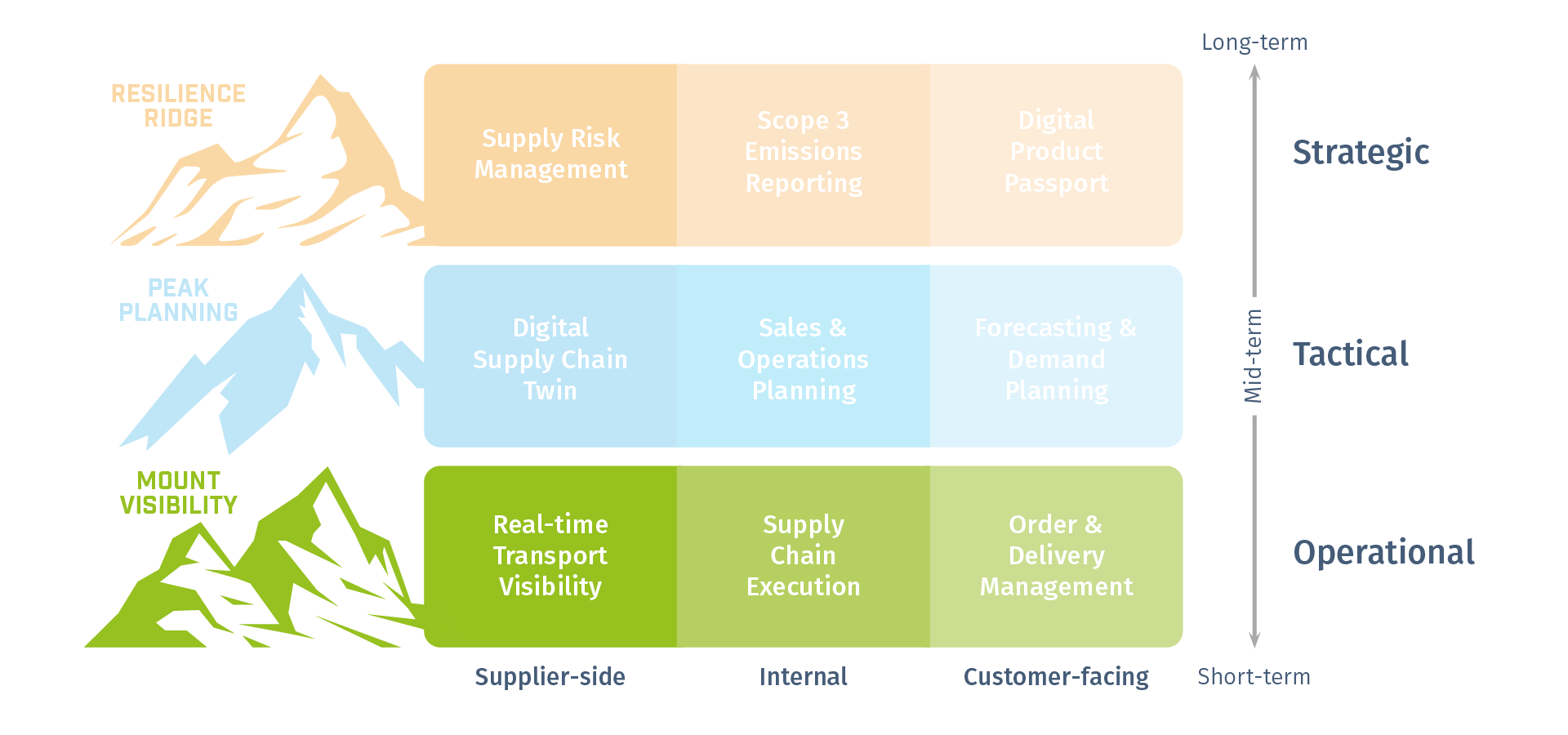
How to read this overview
The matrix above shows how the three break‑out themes connect across the supply chain and decision horizon. From Resilience Ridge (strategic, long‑term) to Peak Planning (tactical, mid‑term) and Mount Visibility (operational, short‑term), each theme addresses a different layer of supply chain decision‑making — from suppliers to customers.